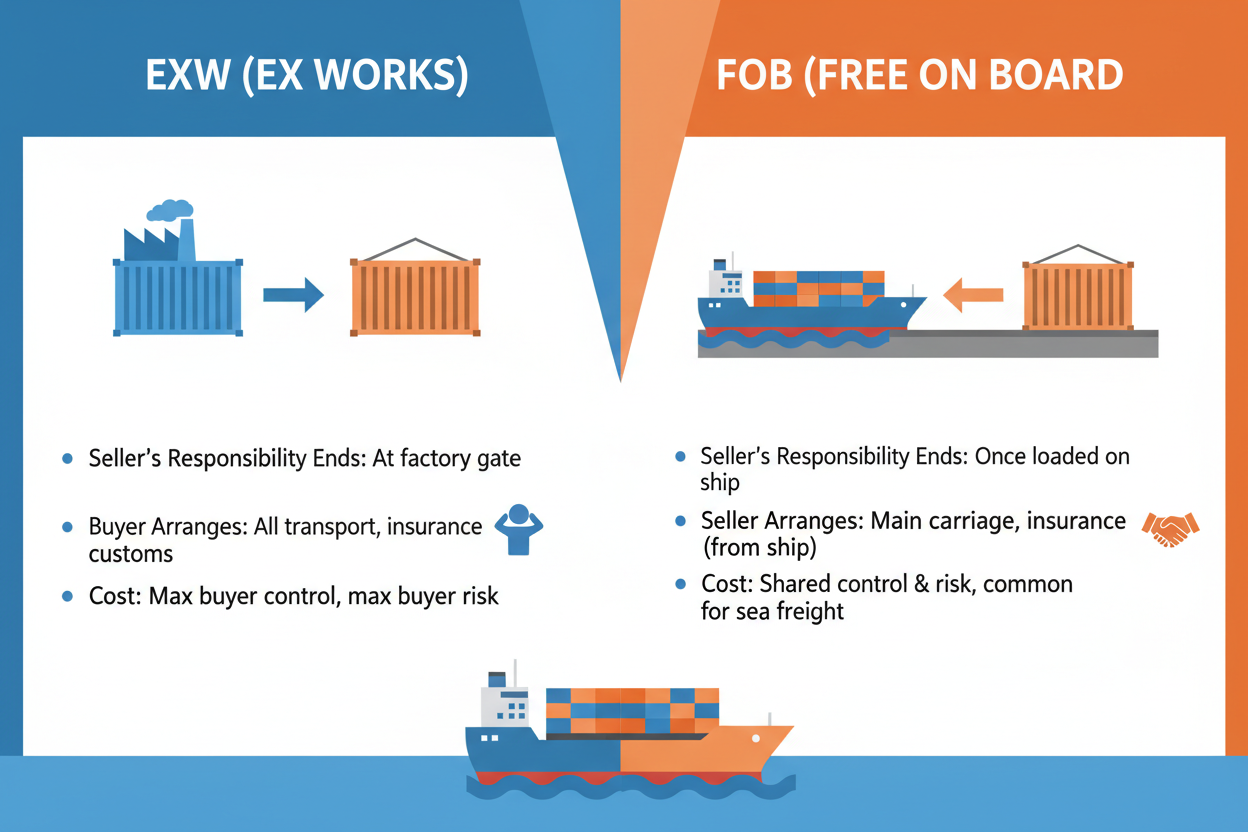
Understanding costs, responsibilities, hidden charges, and the mistakes importers must avoid.
When sourcing products from China, you will frequently receive supplier quotations marked EXW Guangzhou, EXW Shenzhen, or FOB Shanghai.
At first glance, these may look like simple shipping terms.
But the difference between EXW and FOB can significantly affect your transportation costs, customs responsibilities, operational risks, and ultimately your profit margins.
Imagine receiving two quotations for the same product:
- Supplier A: EXW Guangzhou — $8,000
- Supplier B: FOB Shenzhen — $8,600
Which supplier is offering the better deal?
Many first-time importers would immediately choose Supplier A because its quotation is $600 cheaper.
But what if the additional costs of collecting the goods, loading them, transporting them to the port, completing export formalities, and arranging port operations exceed that difference?
Suddenly, the supposedly cheaper offer may become the more expensive option.
The lowest supplier quotation does not necessarily mean the lowest total purchasing cost.
In this guide, we explain the differences between EXW and FOB under Incoterms® 2020, examine the responsibilities of buyers and sellers, compare real-world cost scenarios, and help importers make informed decisions when purchasing from Chinese manufacturers.
1. What Are Incoterms and Why Do They Matter?
Incoterms, short for International Commercial Terms, are standardized international trade rules published by the International Chamber of Commerce (ICC).
They define how specific responsibilities, costs, and risks are allocated between sellers and buyers in international commercial transactions.
These include:
- Delivery of goods
- Transportation arrangements
- Export and import customs formalities
- Loading and handling responsibilities
- Allocation of transportation costs
- Transfer of risk from seller to buyer
- Insurance obligations, where applicable
The current edition, Incoterms® 2020, contains 11 rules.
EXW and FOB are two commonly encountered terms in supplier quotations.
However, they work very differently.
EXW places very limited delivery obligations on the seller, while FOB requires the seller to deliver the goods on board a vessel at the agreed port of shipment.
An important clarification: Incoterms do not automatically determine ownership transfer, payment methods, or remedies for breach of contract. These matters must be addressed separately in the sales agreement.
2. What Does EXW Mean?
EXW stands for Ex Works, commonly translated as “Ex-Factory” or “À l’usine”.
Under EXW, the seller fulfills its delivery obligation by placing the goods at the buyer’s disposal at the named location, usually the factory or warehouse.
For example:
EXW Guangzhou, China — Incoterms® 2020
The supplier is generally responsible for:
- Manufacturing or preparing the products
- Packaging them as required by the sales contract
- Making the goods available at the agreed location
- Notifying the buyer when the goods are ready for collection
The buyer is generally responsible for:
- Loading the goods onto the collection vehicle
- Arranging collection from the factory
- Paying inland transportation costs
- Arranging export customs clearance
- Paying applicable origin handling and port charges
- Organizing international freight
- Arranging cargo insurance, if desired
- Completing import customs clearance
- Paying import duties and taxes
- Organizing delivery to the final destination
Unless the parties agree otherwise, the seller does not have to load the goods onto the collecting vehicle or clear them for export.
When does risk transfer under EXW?
Under EXW, risk generally transfers to the buyer when the goods are placed at the buyer’s disposal at the named delivery location, ready for collection and not loaded onto the collecting vehicle.
This means that the buyer may bear the risk during loading at the factory, even before the goods leave the premises.
EXW gives the buyer extensive control over logistics, but also places substantial operational responsibility on the buyer.
3. What Does FOB Mean?
FOB stands for Free On Board.
Under FOB, the seller is responsible for delivering the goods on board the vessel nominated by the buyer at the agreed port of shipment.
For example:
FOB Shenzhen, China — Incoterms® 2020
The Chinese supplier generally handles:
- Preparing and packaging the goods
- Inland transportation to the port
- Export customs clearance
- Relevant origin handling operations
- Loading the goods on board the nominated vessel
The buyer generally handles:
- Arranging the main international sea freight
- Paying the international freight costs
- Cargo insurance, if desired
- Destination port charges
- Import customs clearance
- Import duties and taxes
- Inland delivery at destination
When does risk transfer under FOB?
Risk transfers from the seller to the buyer when the goods are loaded on board the vessel at the agreed port of shipment.
This is significantly different from EXW.
Under FOB, the seller bears the relevant risks until the goods are on board the vessel.
FOB reduces the buyer’s responsibilities at origin compared with EXW.
However, FOB applies specifically to sea and inland waterway transportation. It is not intended for air freight or general multimodal transportation.
4. EXW vs FOB: Key Differences
| Criteria | EXW | FOB |
|---|---|---|
| Full meaning | Ex Works | Free On Board |
| Typical delivery point | Factory or warehouse | On board the vessel at the named origin port |
| Factory loading | Generally buyer | Seller bears delivery obligations through vessel loading |
| Inland transport in China | Buyer | Seller |
| Export customs clearance | Buyer | Seller |
| Origin port handling | Generally buyer | Seller, to the extent required for on-board delivery |
| Loading on vessel | Buyer arranges through its transport chain | Seller |
| Main international freight | Buyer | Buyer |
| Cargo insurance obligation | Neither party required by EXW | Neither party required by FOB |
| Import customs clearance | Buyer | Buyer |
| Import duties and taxes | Buyer | Buyer |
| Risk transfers | At the named delivery location, before collection/loading | When goods are on board the vessel |
| Transport suitability | Any mode | Sea and inland waterway only |
The essential difference is straightforward:
EXW means the buyer takes responsibility from the agreed collection point. FOB means the seller remains responsible until the goods are delivered on board the vessel.
5. Why EXW Prices Often Look Cheaper
When comparing supplier quotations, EXW prices are frequently lower than FOB prices.
That is because EXW excludes many services that the supplier must provide under FOB.
For example, an EXW quotation generally does not include:
- Loading the collection vehicle, unless separately agreed
- Inland transportation to the export port
- Export customs clearance
- Port handling charges
- Vessel loading obligations
Under FOB, the supplier must account for the costs of fulfilling these additional responsibilities.
Therefore, a higher FOB price does not necessarily mean the supplier is charging more for the actual products.
It may simply mean that more logistics services are included.
Comparing EXW and FOB prices without adjusting for their different cost structures is like comparing two products with different delivery packages.
You must compare equivalent scopes.
6. EXW vs FOB: A Practical Cost Comparison
Let’s consider a hypothetical importer purchasing equipment from a manufacturer in Guangzhou.
The goods will be exported through Shenzhen and shipped to Abidjan, Côte d’Ivoire.
The following figures are illustrative only and do not represent actual shipping quotations.
Option A: EXW Guangzhou
| Cost item | Amount |
|---|---|
| EXW product price | $8,000 |
| Factory loading | $80 |
| Inland transport to Shenzhen | $250 |
| Export customs clearance and documentation | $120 |
| Origin port handling and vessel loading | $250 |
| International sea freight | $1,200 |
| Cargo insurance | $100 |
| Destination charges | $500 |
| Customs brokerage | $200 |
| Inland delivery in Côte d’Ivoire | $300 |
| Total before duties and taxes | $11,000 |
Option B: FOB Shenzhen
| Cost item | Amount |
|---|---|
| FOB product price | $8,600 |
| International sea freight | $1,200 |
| Cargo insurance | $100 |
| Destination charges | $500 |
| Customs brokerage | $200 |
| Inland delivery in Côte d’Ivoire | $300 |
| Total before duties and taxes | $10,900 |
Illustrative cost difference
$100
FOB is cheaper in this scenario.
Despite having a product quotation that is $600 higher, the FOB option produces a lower total cost.
The lesson?
An EXW quotation can appear cheaper at the factory while becoming more expensive after origin logistics costs are included.
Of course, the reverse can also happen.
A buyer with an efficient logistics network may obtain lower origin transportation and handling costs than the supplier and find EXW more competitive.
That is why both options should be evaluated based on the complete cost structure.
7. The Biggest EXW Mistake: Underestimating Export Customs Responsibilities
One of the most important differences between EXW and FOB concerns export customs clearance.
Under FOB, the seller is responsible for export clearance.
Under EXW, the buyer generally bears that responsibility.
This can create practical difficulties for overseas importers purchasing from China.
Why?
Because the buyer may not be established in China or may lack the necessary arrangements to complete export declarations and related procedures.
Chinese export customs procedures must be handled by parties legally permitted to carry out the relevant formalities.
A foreign buyer cannot simply assume that they can personally complete every export process.
They may need an authorized customs broker, exporter, or logistics service provider, subject to the applicable regulations and transaction structure.
The exporter of record, customs documentation, tax treatment, and contractual responsibilities should all be clarified before shipment.
For overseas buyers without an established export logistics arrangement in China, EXW can introduce unnecessary operational complexity.
This is one reason why FCA may be more suitable than EXW for many international transactions.
8. What Happens If Goods Are Damaged During Factory Loading?
Imagine that you purchase a heavy industrial machine under:
EXW Foshan, China — Incoterms® 2020
Your freight forwarder sends a truck to collect the machine.
During loading, the equipment falls and suffers significant damage.
Who bears the risk?
Under standard EXW terms, risk generally passes when the seller places the goods at the buyer’s disposal at the named location, ready for collection.
The seller is not required to load the goods.
Therefore, the buyer may bear the risk of damage during loading.
However, the actual outcome may depend on the contract, the circumstances, and whether a party was negligent or breached an applicable obligation.
Now consider a FOB arrangement.
The seller bears the risk until the goods are loaded on board the vessel at the agreed port.
The difference in risk exposure can be substantial.
For heavy machinery, fragile equipment, or high-value goods, the loading and handling arrangements deserve particular attention.
Never assume that the factory automatically bears responsibility for damage simply because the goods are still on its premises.
9. Does EXW Give Buyers More Control?
In many cases, yes.
EXW allows the buyer to organize most of the logistics chain, beginning at the agreed collection location.
For experienced importers, this can be advantageous.
Direct control over collection
The buyer can select the trucking company responsible for collecting the goods from the supplier.
Logistics consolidation
A buyer purchasing from several factories may arrange collection from different locations and consolidate goods at a warehouse.
Freight negotiation
The buyer can negotiate directly with logistics providers for origin transportation, international freight, and other services.
Better operational coordination
An importer with an established sourcing and logistics network may coordinate inspections, collection, consolidation, and shipping according to a centralized plan.
But these advantages depend on the buyer’s ability to manage the process effectively.
More logistics control is valuable only when the buyer has the expertise and partners to exercise that control.
Otherwise, EXW can create more problems than it solves.
10. Is FOB Better for First-Time Importers?
FOB can be more manageable than EXW for first-time importers shipping by sea.
The supplier handles important origin-side responsibilities, including export clearance and delivery on board the vessel.
The buyer can then concentrate on:
- Selecting a reliable freight forwarder
- Arranging the main sea freight
- Obtaining cargo insurance
- Preparing import documentation
- Understanding destination charges
- Organizing customs clearance and final delivery
This division can reduce the number of origin-side arrangements the buyer must manage.
However, FOB is not a complete shipping solution.
The buyer still needs to understand freight rates, insurance, destination costs, and customs obligations.
Additionally, FOB is not necessarily the most technically appropriate term for every sea shipment.
For containerized cargo, FCA may be preferable.
11. Why FOB Is Not Always Ideal for Containerized Shipments
Many importers use FOB automatically whenever their goods are transported by sea.
But this practice can create problems for containerized shipments.
Consider a supplier delivering a sealed container to a container terminal.
The container is handed over to the carrier before it is loaded on board the vessel.
Under FOB, the seller’s delivery obligation is fulfilled only when the goods are on board.
This creates a potential mismatch between the physical handover of the container and the contractual transfer of risk.
For this reason, the International Chamber of Commerce generally recommends considering FCA (Free Carrier) for containerized shipments where the goods are handed over to a carrier before vessel loading.
Under FCA, delivery and risk transfer occur at the agreed handover point.
The exact responsibilities depend on whether that point is the seller’s premises or another named location.
For example:
FCA Guangzhou Factory — Incoterms® 2020
Under this arrangement, if delivery occurs at the seller’s premises, the seller loads the goods onto the collecting vehicle and handles export clearance.
The buyer then arranges the onward transportation.
This can be a more practical arrangement than EXW for international buyers collecting goods directly from a Chinese factory.
EXW, FCA, and FOB should not be treated as interchangeable terms.
Each defines a different delivery point and allocation of responsibilities.
12. EXW vs FCA vs FOB: Understanding the Three Options
| Criteria | EXW | FCA at seller’s premises | FOB |
|---|---|---|---|
| Delivery point | Named factory or warehouse | Loaded onto buyer’s collecting vehicle at seller’s premises | On board the vessel |
| Factory loading | Buyer | Seller | Seller’s responsibility within its overall delivery obligation |
| Export clearance | Buyer | Seller | Seller |
| Inland transportation to port | Buyer | Buyer, unless otherwise agreed | Seller |
| Main international freight | Buyer | Buyer | Buyer |
| Risk transfer | When goods are made available for collection | When loaded onto collecting vehicle at seller’s premises | When loaded on board the vessel |
| Transport modes | All modes | All modes | Sea and inland waterway |
| Common use case | Experienced buyer managing collection and export | Buyer-arranged transport with seller handling loading and export | Port-to-port sea trade where on-board delivery is appropriate |
FCA deserves particular attention because it often provides a practical middle ground between EXW and FOB.
The buyer can retain control over transportation while the seller handles export clearance and the required loading obligations at its premises.
For many overseas importers sourcing from China, that can be a more workable arrangement.
13. The Hidden Costs Importers Should Check Under EXW
An EXW quotation should never be evaluated without identifying the additional services required to export the goods.
Before accepting EXW, investigate the following potential costs.
Factory collection
How much will it cost to send a truck to the factory?
Loading equipment
Will the goods require forklifts, cranes, or specialized loading equipment?
Inland transportation
How far is the factory from the departure port, airport, or consolidation warehouse?
Export customs formalities
Who will arrange export clearance, and what charges apply?
Export documentation
Are additional certificates, declarations, or permits required?
Warehouse consolidation
Will goods from several suppliers need to be combined into one shipment?
Port and terminal handling
Which handling, storage, and terminal charges will apply?
International freight
What is the cost of shipping the goods to the destination?
Insurance
Who will arrange cargo insurance, and what risks will it cover?
Destination charges
What costs will be payable upon arrival?
A professional EXW cost comparison must include the entire logistics process, not simply the factory selling price.
14. Can EXW Be Useful When Buying from Multiple Chinese Suppliers?
Yes.
Consider an importer purchasing products from five different factories in Guangdong Province.
The factories are located in Guangzhou, Foshan, Dongguan, Zhongshan, and Shenzhen.
Instead of asking each supplier to arrange a separate export shipment, the buyer may work with a sourcing and logistics partner to coordinate collections.
The goods can be transported to a consolidation warehouse, inspected, combined, and prepared for international shipment.
This approach may offer operational benefits:
- Coordinated factory collections
- Centralized quality inspections
- Better packaging oversight
- Consolidated shipping arrangements
- Improved visibility across multiple orders
- Potentially lower combined logistics costs
However, EXW is not a prerequisite for consolidation.
FCA or other appropriately negotiated delivery terms can also support consolidated shipping.
The choice should reflect the actual collection process, export clearance arrangements, and commercial responsibilities.
15. Common EXW and FOB Mistakes Importers Must Avoid
Mistake 1: Assuming EXW is always cheaper
The EXW price excludes services that may already be included in FOB.
Always compare equivalent total costs.
Mistake 2: Ignoring export clearance obligations
Under EXW, the buyer generally handles export clearance.
This may be difficult for overseas buyers without suitable arrangements in China.
Mistake 3: Assuming the supplier must load goods under EXW
Under standard EXW terms, the seller is not required to load the collecting vehicle.
Mistake 4: Believing FOB includes international sea freight
FOB does not require the seller to pay for the main international freight.
That responsibility generally belongs to the buyer.
Mistake 5: Using FOB for air freight
FOB is designed for sea and inland waterway transport.
For air freight, FCA or another suitable Incoterm should be considered.
Mistake 6: Failing to specify the delivery location
Terms such as “EXW China” or “FOB Guangdong” are insufficiently precise.
The named place or port should be clearly identified.
Mistake 7: Confusing risk transfer with ownership transfer
Incoterms address delivery, cost, and risk obligations, but do not automatically determine when legal ownership transfers.
Mistake 8: Ignoring the actual handover process
If a container is handed over to a carrier at a terminal before vessel loading, FCA may better reflect the operation than FOB.
16. Which Incoterm Should African Importers Choose?
For buyers importing from China to markets such as Côte d’Ivoire, Ghana, Nigeria, Senegal, Cameroon, and other African countries, the choice between EXW and FOB depends on several practical considerations.
Your experience with Chinese logistics
Do you have reliable transport, customs, and forwarding partners in China?
The type of cargo
Are you importing machinery, electronics, construction materials, consumer goods, or containerized merchandise?
The location of your suppliers
Are your factories near the export port, or do they require substantial inland transportation?
Your shipment structure
Are you purchasing from one supplier or consolidating products from several manufacturers?
Your need for control
Do you want to organize transportation from the factory, or would you prefer the supplier to manage delivery to the port?
Your export clearance arrangements
Can the necessary customs procedures be completed properly under the proposed transaction structure?
For buyers without established logistics arrangements in China, EXW may create unnecessary complications.
FOB may be simpler for suitable maritime shipments.
FCA may be a better alternative when goods are collected from the factory or delivered to a carrier before vessel loading.
The best Incoterm is not necessarily the one with the lowest quoted price. It is the one that matches your shipment, operational capabilities, and risk exposure.
17. How Herogroupe Helps Importers Compare EXW and FOB Quotations
At Herogroupe, we believe that successful sourcing requires more than negotiating a competitive product price.
A supplier quotation is only one component of the total import cost.
An importer must also understand what happens between the factory and the final destination.
As a China-based sourcing and procurement partner, Herogroupe supports international buyers with:
- Supplier identification and verification
- Product sourcing and quotation comparison
- Negotiation of commercial terms
- Factory and product inspections
- Procurement coordination
- Communication with Chinese manufacturers
- Logistics coordination with freight partners
When reviewing EXW and FOB offers, we encourage buyers to ask important questions:
What services are included in the quoted price?
Who is responsible for loading the goods at the factory?
Who will handle export customs clearance?
What are the inland transportation costs?
Where exactly does the risk transfer?
Is FOB technically appropriate for the shipment, or should FCA be considered?
What is the estimated total landed cost?
These questions help importers avoid misunderstandings before making payment.
Our objective is to help buyers source more intelligently, improve visibility, and coordinate procurement with greater confidence.
18. EXW vs FOB: Final Decision Checklist
Before accepting your supplier’s quotation, review the following questions.
Pre-shipment checklist
0/10 checkedHave I confirmed the exact named delivery location or port?Do I understand when the risk transfers?Have I confirmed who loads the goods at the factory?Do I know who handles export customs clearance?Have I obtained an estimate of inland transportation costs?Have I compared equivalent EXW and FOB total costs?Have I identified all origin handling charges?Do I have reliable freight and customs partners in China?Is FCA more appropriate for my shipment?Have I estimated the complete landed cost?
Reset checklist
If you cannot confidently answer these questions, request further clarification before approving the transaction.
Conclusion: EXW or FOB — Which Is Better?
EXW and FOB are both legitimate international trade terms, but they allocate responsibilities very differently.
EXW gives the buyer extensive responsibility from the agreed collection point, including loading and export clearance under the standard rule.
FOB requires the seller to deliver the goods on board the nominated vessel at the named port of shipment and complete export clearance.
The choice affects transportation costs, operational control, customs procedures, and risk exposure.
For experienced importers with reliable logistics partners in China, EXW can offer flexibility.
For suitable maritime shipments, FOB can reduce the buyer’s origin-side responsibilities.
And for many factory collections and containerized shipments, FCA deserves serious consideration as a practical alternative.
Ultimately, the smartest decision is not based on the lowest factory quotation.
It is based on understanding the complete transaction.
Because in international trade, a cheap EXW price can become an expensive mistake if you overlook everything that happens after the goods leave the factory.
At Herogroupe, we help international buyers navigate supplier verification, sourcing, procurement, quality control, and logistics coordination from China.
Source with confidence. Understand your costs. Protect your margins.
Herogroupe — Your sourcing and procurement partner on the ground in China.
Contact: contact@herogroupe.com Website: www.herogroupe.com