When importing products from China, finding the right supplier and negotiating a good price are only part of the equation.
You still need to get the goods from China to your destination.
And one of the most important logistics decisions you will make is:
Should you ship by sea or by air?
At first glance, the choice may seem simple.
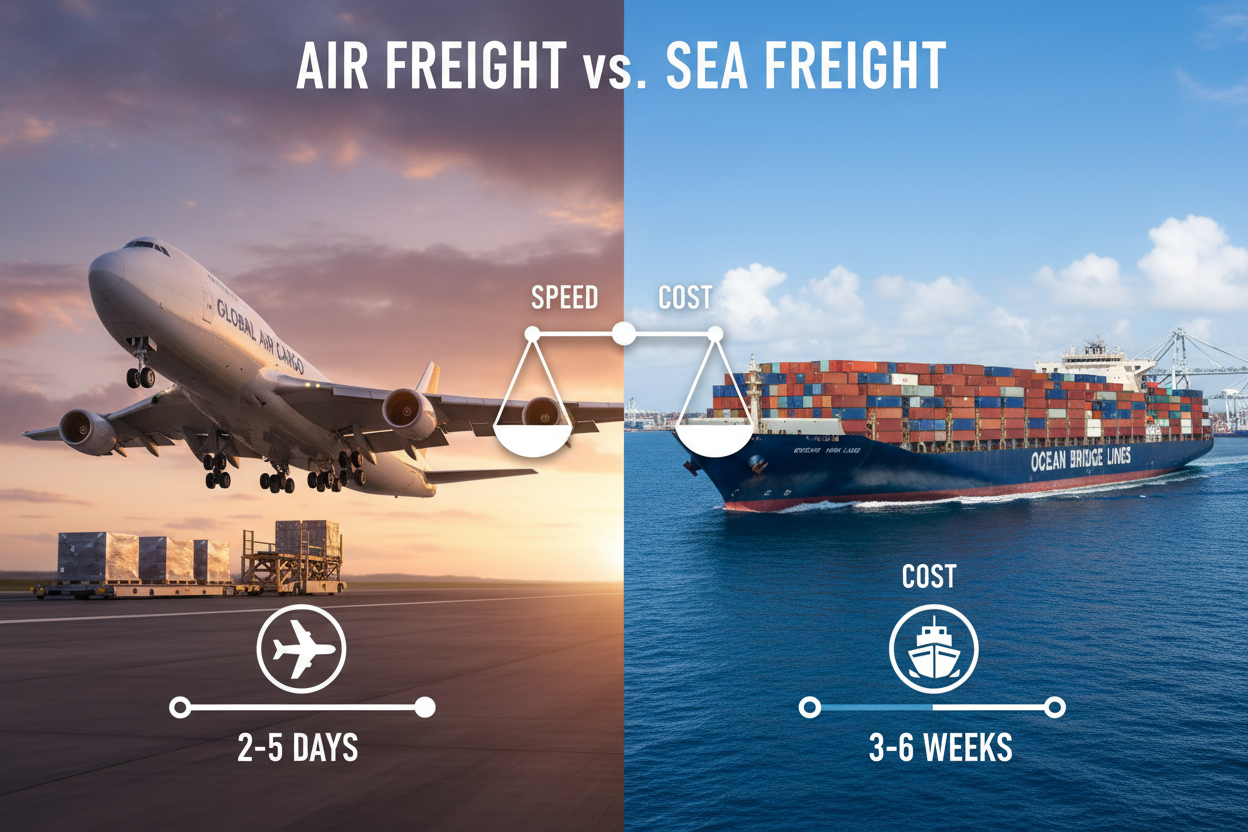
Sea freight = cheaper.
Air freight = faster.
But international logistics is more complex than that.
The right choice depends on your shipment’s weight and volume, product value, urgency, destination, inventory requirements, and total landed cost.
A shipping method that saves money on freight can create expensive inventory delays. At the same time, paying for air freight when your products are bulky and non-urgent can destroy your profit margin.
In this guide, we compare sea freight and air freight to help importers make better shipping decisions when sourcing from China.
1. What Is Sea Freight?
Sea freight involves transporting goods internationally by cargo vessel.
It is one of the most common transportation methods for international trade, particularly for large or heavy shipments.
When importing from China by sea, your cargo will generally be shipped using one of two arrangements:
FCL — Full Container Load
FCL means you book a full container for your shipment.
Common container options include:
- 20-foot container
- 40-foot container
- 40-foot High Cube container
FCL can be suitable when your shipment is large enough to justify using a dedicated container.
LCL — Less than Container Load
LCL allows you to ship goods without filling an entire container.
Your cargo shares container space with shipments belonging to other importers.
The freight forwarder consolidates multiple shipments in China and separates them again at the destination.
This makes sea freight accessible even when your shipment is not large enough for a full container.
2. What Is Air Freight?
Air freight transports commercial cargo by aircraft.
It is generally used when goods need to arrive significantly faster than they would by sea.
Air freight can be particularly useful for:
- Urgent orders
- High-value products
- Lightweight goods
- Smaller commercial shipments
- Samples
- Spare parts
- Product launches
- Emergency inventory replenishment
However, speed comes at a cost.
Air freight is generally much more expensive than sea freight, particularly for heavy or bulky cargo.
3. Sea Freight vs Air Freight: The Main Differences
Here is the basic comparison:
| Factor | Sea Freight | Air Freight |
|---|---|---|
| Speed | Slower | Faster |
| Freight cost | Generally lower | Generally higher |
| Large shipments | Very suitable | Often expensive |
| Heavy cargo | Very suitable | Can become costly |
| Small urgent shipments | Less suitable | Very suitable |
| Bulky products | Usually more economical | Often expensive |
| High-value goods | Depends on requirements | Often attractive for speed |
| Inventory replenishment | Requires more planning | Useful for urgent replenishment |
| Environmental impact | Generally lower per unit of cargo | Generally higher |
| Transit predictability | Can be affected by port schedules and congestion | Faster, but still subject to capacity and operational disruptions |
The decision should therefore not be based on freight price alone.
4. The Biggest Advantage of Sea Freight: Cost Efficiency
For large, heavy, or bulky shipments, sea freight is generally the more economical option.
Imagine importing:
- Furniture
- Machinery
- Building materials
- Tires
- Large quantities of electronics
- Household appliances
- Thousands of consumer products
Sending such shipments by air can quickly become commercially unrealistic.
Sea freight allows importers to move substantial quantities while keeping transportation cost per unit relatively low.
This is particularly important for products with:
- Low or moderate unit value
- Large dimensions
- High weight
- Lower profit margins
If transportation costs represent too large a percentage of the product value, the product may no longer be competitive in the destination market.
5. The Biggest Advantage of Air Freight: Speed
The major advantage of air freight is speed.
While international sea freight can take weeks depending on the route, air transportation can move goods between countries much faster.
However, importers should distinguish between:
Flight time and total door-to-door transit time.
Your shipment does not magically arrive at your warehouse as soon as the aircraft lands.
The complete process may include:
Factory pickup → Export handling → Airport processing → Flight → Import customs clearance → Destination handling → Final delivery
Similarly, sea freight involves:
Factory pickup → Export handling → Port operations → Vessel transit → Destination port → Customs clearance → Final delivery
When comparing quotations, always ask what the stated transit time actually covers.
6. Weight vs Volume: A Critical Difference
One of the most important differences between sea and air freight is how shipping charges are calculated.
Many new importers focus only on kilograms.
That can be a mistake.
Air Freight
Air freight pricing considers the space your shipment occupies as well as its actual weight.
This is where volumetric weight or dimensional weight becomes important.
A shipment can physically weigh only 100 kg but occupy enough aircraft space to be charged at a much higher weight.
The chargeable weight is generally determined according to the applicable carrier or forwarder rules by comparing actual gross weight with volumetric weight.
This means:
Large + Lightweight = Potentially expensive by air
Think of products such as:
- Pillows
- Foam products
- Large plastic items
- Lightweight furniture
- Bulky packaging
They may not weigh much, but they consume valuable aircraft cargo space.
Sea Freight
For LCL sea freight, cargo is commonly assessed based on its volume, often expressed in CBM — cubic meters, with applicable weight/measurement rules depending on the forwarder and route.
For FCL, the economics are primarily related to the container and applicable weight limits rather than charging every product individually by volumetric weight.
Understanding your shipment’s:
Gross weight + Carton dimensions + Total CBM
is therefore essential before comparing freight options.
7. Don’t Compare Freight Rates Without Comparing the Same Scope
Suppose you receive two quotations:
Sea freight: $1,000
Air freight: $2,500
It may appear obvious that sea freight is cheaper.
But what exactly is included in each price?
A freight quotation may include or exclude:
- Factory pickup
- Export customs declaration
- Origin handling charges
- Documentation
- Port or airport charges
- Main freight
- Fuel-related surcharges
- Destination handling
- Customs clearance service
- Duties and taxes
- Warehousing
- Final delivery
One quotation might be port-to-port while another is door-to-door.
Comparing those two numbers directly would be misleading.
Before choosing a freight option, ask:
“What exactly is included in this quotation?”
8. Freight Cost Is Not the Same as Landed Cost
A common importing mistake is choosing the shipping option with the lowest visible freight price.
The real business question should be:
What will this product cost me when it actually reaches my warehouse?
Your landed cost may include:
Product cost + Sourcing/procurement cost + Inspection + Packaging + Origin logistics + International freight + Insurance + Customs-related costs + Duties/taxes + Destination charges + Final delivery
Not every shipment will contain every one of these cost components, but the principle remains the same.
The cheapest freight quotation does not automatically create the lowest landed cost.
9. When Sea Freight Usually Makes More Sense
Sea freight may be appropriate when:
Your shipment is large
The larger the shipment becomes, the stronger the economic case for sea freight can become.
Your products are heavy
Heavy commercial cargo can be prohibitively expensive to transport by air.
Your products are bulky
Large-volume products can generate high volumetric charges by air.
The order is not urgent
If you have sufficient inventory and can plan ahead, you may not need to pay a premium for speed.
Your margins require lower transportation costs
For price-sensitive products, reducing freight cost per unit can be essential.
You import regularly
Businesses with good inventory planning can schedule replenishment early enough to take advantage of slower transportation.
10. When Air Freight Usually Makes More Sense
Air freight may be appropriate when:
The shipment is urgent
If you need the goods quickly, the additional freight cost may be justified.
The shipment is relatively small
For smaller shipments, the difference between transport methods may need to be evaluated against the additional time and handling involved.
The products have high value relative to their weight
For compact, high-value goods, air freight may represent a manageable percentage of the product value.
You need samples
Waiting for sea freight rarely makes sense for a small sample needed for product approval.
You are facing a stockout
Running out of inventory can cost more than paying higher freight charges.
You need replacement parts urgently
If a critical machine or business operation is stopped because of a missing component, speed may matter more than freight cost.
11. Sometimes the Best Solution Is Both
The decision does not always have to be:
Sea OR Air.
Sometimes the most effective strategy is:
Sea AND Air.
Suppose you order 5,000 units from China and urgently need 500 units to avoid a stockout.
Instead of shipping all 5,000 units by air, you could potentially:
Ship 500 units by air → Restore inventory quickly
and
Ship 4,500 units by sea → Reduce the overall logistics cost
This is sometimes called a split shipment strategy.
It can help businesses balance:
Speed + Inventory availability + Freight cost
This approach can also be useful for product launches.
A smaller quantity arrives quickly by air while the main inventory travels by sea.
12. Consider the Value of Time
Suppose sea freight saves you $3,000 compared with air freight.
That sounds like an obvious saving.
But what if waiting several additional weeks causes you to lose $10,000 in sales?
Then the cheaper freight option may not be the cheaper business decision.
On the other hand, if the products will simply sit in your warehouse after arrival, paying thousands of dollars extra for air freight may provide little value.
This is why importers should consider the value of time, not simply the price of transportation.
Ask yourself:
What does one additional week of waiting actually cost my business?
13. Inventory Planning Can Save More Than Freight Negotiation
One of the most effective ways to reduce logistics costs is not necessarily negotiating harder with the freight forwarder.
It is planning earlier.
Poor inventory planning creates emergencies.
And emergencies often create expensive logistics decisions.
Consider the difference:
Good planning:
Order early → Produce → Inspect → Ship by sea → Replenish inventory on time
Poor planning:
Stock almost finished → Urgent order → Rush production → Air freight → Higher logistics cost
Air freight is extremely valuable when it is genuinely needed.
But repeatedly using it because inventory was ordered too late can significantly reduce profitability.
14. Packaging Can Change Your Freight Cost
Packaging does more than protect your products.
It also affects transportation costs.
Imagine a supplier uses unnecessarily large cartons.
The products remain exactly the same.
But your shipment volume increases.
For sea freight, this may increase the total CBM.
For air freight, it may increase volumetric weight.
You could therefore pay more freight simply because the packaging was poorly optimized.
Good packaging should balance:
Product protection + Space efficiency + Logistics cost
This is one reason packaging inspection and logistics planning should not be treated as completely separate activities.
15. Consider the Nature of the Product
Not every product can be shipped in the same way.
Some goods may be subject to special transportation requirements, restrictions, documentation, or carrier acceptance rules.
Examples can include:
- Batteries
- Power banks
- Certain electronics
- Chemicals
- Liquids
- Magnetic products
- Dangerous goods
- Temperature-sensitive products
- Oversized machinery
For example, lithium-battery products may require specific transport documentation, testing, packaging, labeling, or carrier approval depending on the product and transport mode.
Before promising a shipping method to your customer, verify that the cargo can actually be accepted under the applicable transportation requirements.
16. Customs Clearance Still Matters
Choosing air instead of sea does not eliminate customs requirements.
The importer may still need to deal with:
- Commercial invoice
- Packing list
- Transport documents
- Product classification
- Customs declaration
- Import permits where required
- Certificates where applicable
- Duties and taxes
The exact requirements depend on the product and destination country.
A fast aircraft does not compensate for incorrect documentation.
Your goods can arrive quickly and still face delays if the customs paperwork is incomplete or inaccurate.
17. Sea Freight Risks Importers Should Consider
Sea freight offers major cost advantages, but importers should plan for potential issues such as:
- Longer transit times
- Port congestion
- Vessel schedule changes
- Transshipment delays
- Customs delays
- Demurrage or storage charges under certain circumstances
- Moisture and humidity exposure
- Cargo handling risks
Long sea journeys also make proper packaging particularly important.
Products may spend weeks inside a container exposed to changing temperatures and humidity conditions.
18. Air Freight Risks Importers Should Consider
Air freight is faster, but it is not risk-free.
Potential issues can include:
- Higher transportation costs
- Capacity constraints
- Volumetric weight charges
- Restrictions on certain products
- Airport handling charges
- Customs delays
- Flight schedule changes
- Additional requirements for dangerous or restricted goods
Importers should therefore avoid assuming that:
“Air freight = guaranteed instant delivery.”
It is faster transportation, but it remains part of an international logistics chain.
19. Questions to Ask Before Choosing Sea or Air Freight
Before making your decision, answer these questions:
- What is the total gross weight?
- What is the total shipment volume in CBM?
- What are the carton dimensions?
- What is the product value?
- How urgently do I need the goods?
- What happens financially if the shipment arrives later?
- What is included in each freight quotation?
- Are there destination charges?
- Are the products subject to shipping restrictions?
- Is the packaging optimized?
- Do I have enough inventory to wait for sea freight?
- Would splitting the shipment between sea and air make more sense?
Once you know these answers, the decision becomes much easier.
Quick Decision Guide
Consider Sea Freight If:
☐ Your shipment is large
☐ Your products are heavy or bulky
☐ Delivery is not urgent
☐ You have enough inventory
☐ Freight cost per unit is important
☐ You can plan replenishment in advance
Consider Air Freight If:
☐ The shipment is urgent
☐ The cargo is relatively small
☐ The products are compact and higher-value
☐ You need samples quickly
☐ You are facing a stockout
☐ Delayed delivery would cost more than the additional freight
Consider a Split Shipment If:
☐ You need part of the order urgently
☐ The full order is too expensive to ship by air
☐ You want to launch sales before the main shipment arrives
☐ You need to balance inventory availability and logistics cost
So, Which Is Better: Sea Freight or Air Freight?
There is no universal winner.
Sea freight is not automatically better because it is cheaper.
Air freight is not automatically better because it is faster.
The right shipping method is the one that best matches your:
Product + Shipment size + Urgency + Inventory situation + Destination + Profit margin
For one order, that may be sea freight.
For another, air freight.
And sometimes the smartest decision is to use both.
Final Thought
Successful importing is not simply about buying products at the lowest factory price.
You also need to understand what happens between the factory and your warehouse.
A product purchased cheaply can become expensive after freight, handling, customs, duties, storage, and final delivery are added.
That is why logistics should be considered before placing the order, not after production is complete.
At Herogroupe, we support international buyers with product sourcing, supplier verification, procurement coordination, product and packaging inspection, and logistics support from China.
Our objective is not simply to help you find products.
It is to help you make better sourcing and logistics decisions from China to your destination.
Don’t choose the cheapest freight. Choose the shipping strategy that makes sense for your business.
Herogroupe — Source with confidence. Ship with a strategy.
#ChinaSourcing #SeaFreight #AirFreight #InternationalTrade #Logistics #FreightForwarding #ImportFromChina #Procurement #SupplyChain #Herogroupe